
Court Marriage in Karachi | Court Marriage Fee in Karachi | 2026
Secure your court marriage in Karachi through a legally supervised process designed to ensure statutory validity, confidentiality, and procedural compliance. Operating within the wider professional framework of Qanoon Group, our senior marriage lawyers facilitate Free-Will Nikah, lawful registration under the Muslim Family Laws Ordinance, 1961, and issuance of a bilingual marriage certificate recognised for official and international use. Each marriage is handled carefully to avoid procedural defects, unnecessary complications, and documentation errors.
Court marriage in Karachi has become a widely chosen option for couples seeking a lawful, private, and efficient way to solemnize their union. Unlike traditional weddings, which often involve elaborate ceremonies and family negotiations, court marriage focuses on legal recognition, documentation, and compliance with Pakistani family law.
This blog provides a comprehensive breakdown of court marriage in Karachi, including the legal framework, eligibility requirements, documents needed, step‑by‑step procedure, and fee structure in 2026. It also highlights common mistakes, practical tips, and the importance of professional legal assistance.
Introduction: Understanding Court Marriage
A court marriage is an official and legally recognized union of a couple as partners in life. Once solemnized, the couple acquires a lawful status along with all rights and obligations under Pakistani law.
Unlike informal unions or unregistered Nikah ceremonies, court marriage ensures that the relationship is recognized by NADRA (National Database and Registration Authority) and enforceable in courts. This recognition is crucial for matters such as inheritance, custody, divorce, and visa applications.
What Is Court Marriage?
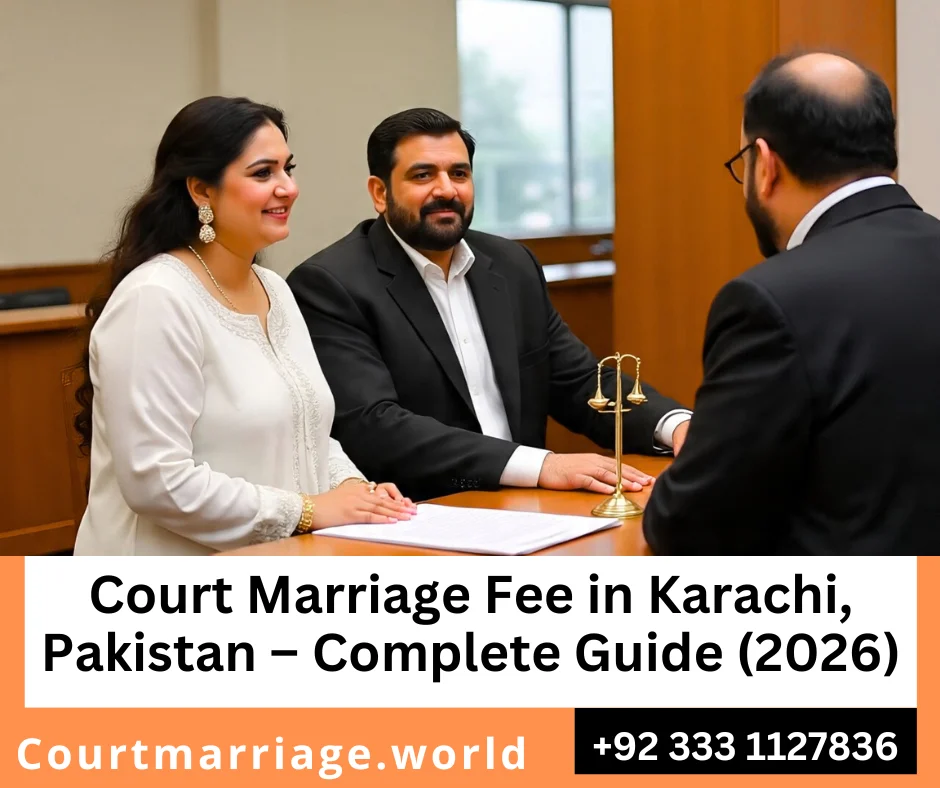
Court marriage is a legal marriage solemnized in court or through a licensed Nikah Khawan in the presence of witnesses. It is then registered with the Union Council and NADRA.
Key Features:
- Conducted in a courtroom or lawyer’s office with proper documentation.
- Requires two Muslim witnesses to certify the marriage.
- Involves Nikah Nama (marriage contract) signed by all parties.
- Results in issuance of a NADRA Marriage Certificate, which is the official proof of marriage.
Eligibility Criteria for Court Marriage in Karachi
To qualify for court marriage in Karachi, couples must meet the following conditions:
- Age Requirement: Both bride and groom must be at least 18 years old (Sindh Child Marriage Restraint Act).
- Mental Capacity: Both must be of sound mind and capable of giving free consent.
- Marital Status: If previously married, divorce or death certificates must be provided.
- Religion: For Muslim marriages, both parties must be Muslim.
- Consent: The bride’s free will affidavit is often required to confirm voluntary consent.
Documents Required for Court Marriage in Karachi
The documentation process is critical. Missing or incorrect documents can delay or invalidate the marriage registration.
Mandatory Documents:
- Original CNICs of bride and groom
- Passport-size photographs of both parties
- Free will affidavit (especially for the bride)
- Nikah Nama signed by bride, groom, witnesses, and Nikah Khawan
- CNICs of two Muslim witnesses
- CNIC of Wali (if applicable)
- Divorce/Khulla certificate (if previously married)
- Death certificate (if widow/widower)
NADRA Requirements:
- NADRA Marriage Registration Form (downloadable in PDF or Word format)
- Birth certificate (if CNIC not available)
- Proof of residence (optional but useful)
Step‑by‑Step Procedure for Court Marriage in Karachi
Here’s how the process unfolds:
- Consultation with Lawyer
- Legal expert verifies eligibility and documents.
- Affidavits and forms are prepared.
- Preparation of Nikah Nama
- Drafted and signed by bride, groom, witnesses, and Nikah Khawan.
- Solemnization of Nikah
- Conducted by a licensed cleric in the presence of witnesses.
- Bride and groom exchange consent (Ijab‑o‑Qubool).
- Registration with Union Council
- Nikah Nama submitted for official registration.
- NADRA Marriage Registration Form completed.
- Issuance of NADRA Marriage Certificate
- Computerized certificate issued after verification.
- This serves as the official proof of marriage.
Court Marriage Fee in Karachi (2026)
The court marriage fee in Karachi varies depending on the lawyer, location, and complexity of the case. Below is a general breakdown:
Service | Estimated Fee (PKR) |
Legal Consultation & Documentation | 7,000 – 10,000 |
Nikah Khawan Services | 6,000 – 7,000 |
Affidavit & Stamp Paper Charges | 1,000 – 2,000 |
NADRA Marriage Certificate | 3,000 – 4,500 |
Court Representation (if required) | 10,000 – 15,000 |
Note: Fees may vary depending on urgency, lawyer’s experience, and additional services such as home Nikah or multilingual documentation.
Common Mistakes to Avoid
- Submitting photocopies instead of original CNICs
- Using unverified witnesses or non‑Muslim witnesses in a Muslim Nikah
- Incorrectly filled Nikah Nama or NADRA form
- Hiring unlicensed Nikah Khawan
- Delaying NADRA registration after Nikah

Practical Tips for Couples
- Book your lawyer and Nikah Khawan in advance
- Double‑check all documents for accuracy
- Bring originals and photocopies of CNICs and certificates
- Ensure witnesses are punctual and informed
- Keep multiple copies of the Nikah Nama and the NADRA marriage certificate
Social Context of Court Marriage in Karachi
Karachi, being Pakistan’s largest metropolitan city, sees a high number of court marriages due to:
- Family opposition to love marriages
- Inter‑caste or inter‑sect unions
- Privacy concerns for couples seeking a simple ceremony
- Legal clarity for overseas visa applications
Court marriage provides couples with a safe, professional, and lawful environment to exercise their rights.
Conclusion
A court marriage in Karachi is a lawful, efficient, and dignified way for couples to solemnize their union. With proper documentation, verified witnesses, and professional legal assistance, the process can be completed smoothly — often within a single day.
By understanding the requirements, procedure, and fee structure, couples can avoid common mistakes and ensure their marriage is legally recognized under Pakistani law.
Key takeaway: Court marriage offers a secure path to marital recognition, protecting couples’ rights while providing them with a NADRA‑issued marriage certificate essential for legal and personal matters.
